
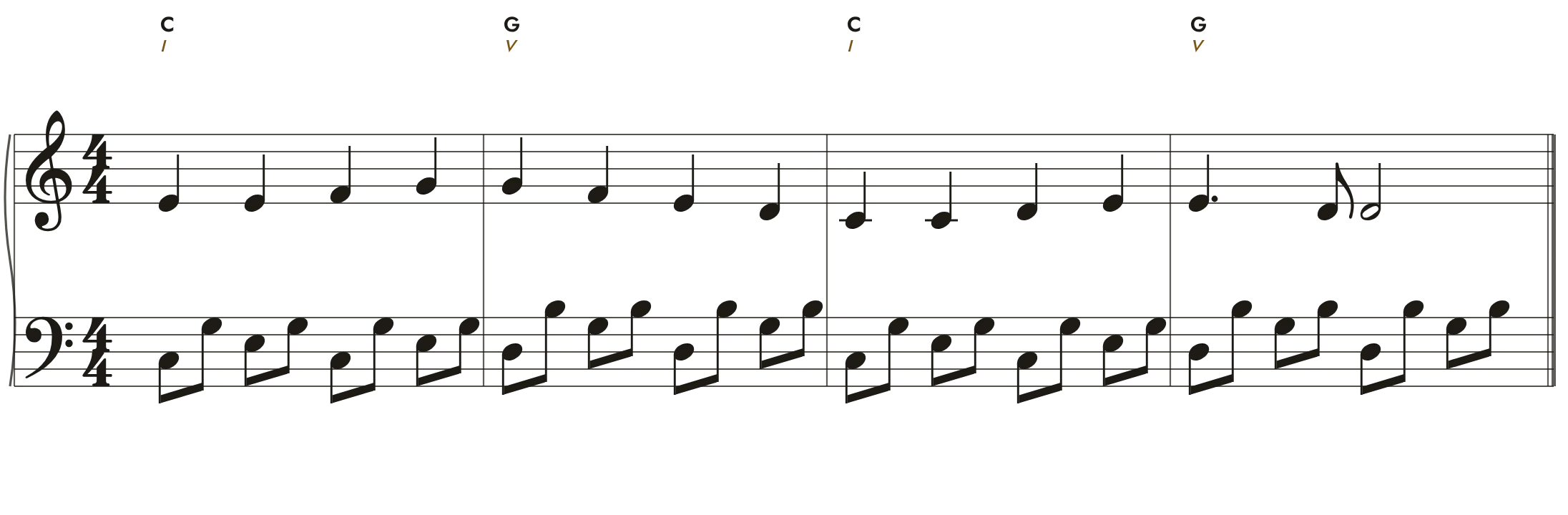
The choral theme from the Ninth Symphony, all four phrases. Stays close to one hand position: the classic first piece.
The story
Beethoven had wanted to set Friedrich Schiller’s poem “An die Freude” (To Joy, 1785) to music for some thirty years. He finally did it in the last movement of his Ninth Symphony, the first time a major composer brought singers into a symphony.
At the premiere in Vienna on 7 May 1824, Beethoven was almost completely deaf. The story goes that when the music ended he was still facing the orchestra, and the contralto Caroline Unger gently turned him around so he could see the audience applauding.
The melody is deliberately simple: it moves mostly by step, like a folk song anyone could sing. That is exactly why it works as a first piece, and why it became a hymn for a whole continent.
Three things to know
- The Council of Europe adopted the melody as its anthem in 1972; the European Union followed in 1985.
- The theme first appears quietly in the cellos and basses, with no words, before the voices take it up.
- Almost every note is a neighbour of the last one: the tune stays inside five notes for most of its length.
How to play it
The third phrase wanders away with quicker notes and drops to a low G. Make the return of the opening tune afterwards feel like coming home.