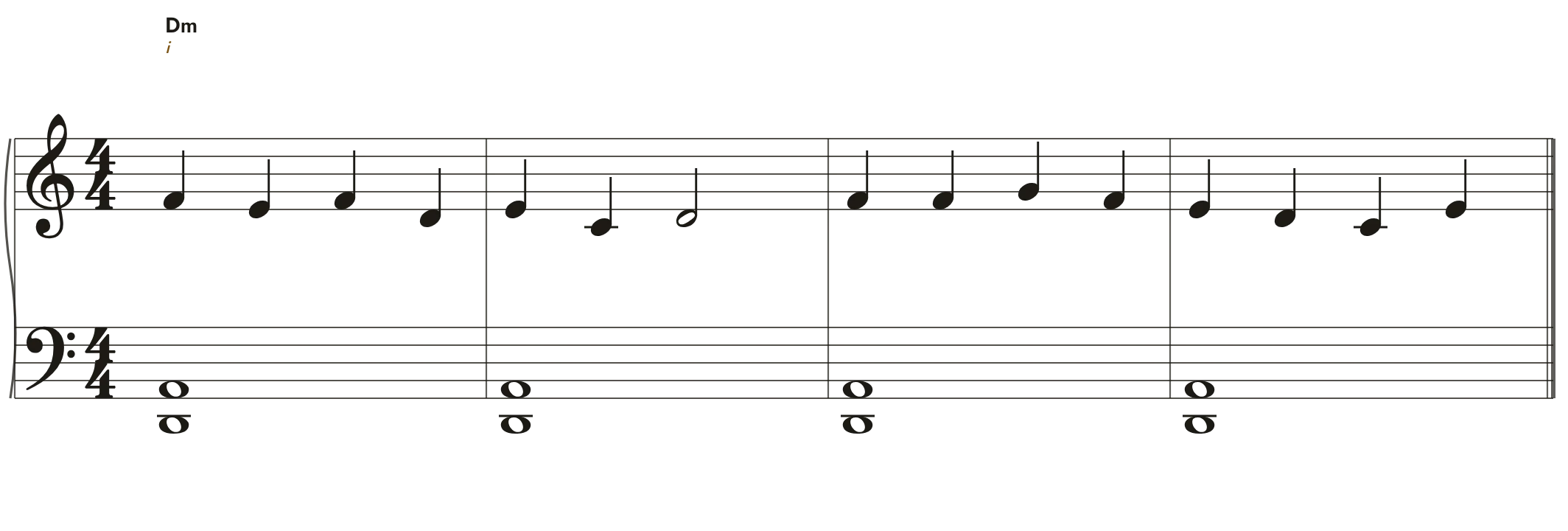
The medieval “Day of Wrath”. Composers from Berlioz to film-score writers quote its first four notes whenever doom approaches. The left hand holds a bare open fifth.
The story
“Dies irae, dies illa”: the day of wrath, that day. This 13th-century Latin poem describes the Last Judgement. It is often attributed to the Franciscan friar Thomas of Celano, though no one can be sure.
For centuries it was sung at funeral masses in the Catholic Church. Its first four notes became so closely tied to death that composers began quoting them whenever they wanted to send a shiver down the audience’s spine.
Berlioz used it in the Symphonie fantastique (1830), Liszt in his Totentanz, Rachmaninoff in many works, and Wendy Carlos in the opening of the film The Shining (1980).
Three things to know
- Gregorian chant was sung in unison, with no harmony and no fixed beat.
- The chant has 19 verses in its full form.
- Rachmaninoff was so drawn to the theme that it appears in at least half a dozen of his works.
How to play it
The opening four notes, falling step by step and turning back, are the famous motif. Once you know them you will hear them in film scores everywhere.